The house on Ash Tree Lane
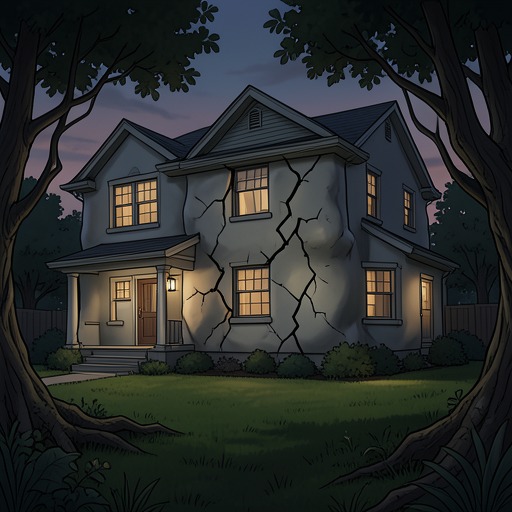
House of LeavesThe house on Ash Tree Lane is not merely the setting of The Navidson Record but its decisive active force: a home that ceases to guarantee shelter and instead makes space itself uncertain. Its impossible dimensions, shifting corridors, absent light, and refusal to submit to measurement turn architecture into a sustained crisis of perception, family life, bodily orientation, and documentary knowledge.
From Home to Uncanny Space
The house first becomes disturbing through a small but physically consequential alteration. In the master bedroom, Will Navidson and Karen Green find a plain white door with a glass knob that does not open into the children’s room as expected, but into a narrow space resembling a walk-in closet. The space is no more than five feet wide and four feet long, with smooth almost-black walls and none of the ordinary features that make a closet useful: no outlets, switches, shelves, hanging rod, or decorative molding. A second identical door opens from the far end into the children’s bedroom. Photographs show that the bedroom wall previously had no door, forcing the household to question not only the building but the reliability of its own perceptions.
The disturbance cannot be resolved as an ordinary property defect. Alicia Rosenbaum, the real-estate agent who sold the house, has no explanation when Karen asks who could be responsible, and the responding officers can do little beyond filing a report. Sheriff Axnard treats the situation as possibly the work of a “crazy carpenter,” a mundane explanation that is absurd precisely because the alteration has no plausible construction history. With the obvious human explanations exhausted, the house shifts from an unusual object into an impossible reality.
Its uncanniness is therefore a loss of domestic protection rather than simply the presence of a visible monster. In the absence of the Navidsons, the home has become something else: not necessarily sinister or openly threatening, but changed in a way that destroys security and well-being. The house remains recognizably a house while no longer functioning as a familiar one, making its domestic form more unsettling than an entirely alien environment would be.
The Quarter-Inch Anomaly
Will Navidson attempts to restore certainty through measurement. He compares the building plans with the dimensions he takes himself, repeatedly moving between a 25-foot Stanley Power Lock and the cold blue pages spread across the bed. His initial suspicion is that the plans contain bad mathematics. Exterior measurements, however, corroborate the plans: the distance from the far end of the master bedroom to the far end of the children’s bedroom totals 32 feet 9 and three-quarter inches, within approximately an inch of the documented figure.
The contradiction appears when Navidson measures the interior. The lengths of the two bedrooms, the newly discovered space, and the intervening walls cannot be reconciled with the exterior dimensions. The house contains more interior distance than its outside permits. When he stretches a fishing line from one side of the building to the other, the line is a quarter of an inch too long, confirming the discrepancy in a form that is tiny in scale but enormous in consequence.
The quarter-inch anomaly turns an intellectual puzzle into a bodily confrontation with impossibility. An Escher print can be closed and put away; the house cannot. Karen refuses the implication and tells Navidson, “I don’t care,” asking him to stop drilling holes in her walls. Navidson persists, measuring six consecutive times in six consecutive segments, yet the minute excess survives every attempt to eliminate it. As his mood darkens, Karen grows quieter, and Chad Navidson and Daisy Navidson respond to the altered atmosphere by hiding elsewhere in the house. The anomaly thus becomes a domestic pressure: a fraction of space that reorganizes the emotional weather of the family.
The house also resists the expectation that an impossible discovery must produce an immediate dramatic climax. Its consequences accumulate patiently. Like an insidious poison whose effects take years to appear, the impossible works gradually on the people who live around it. The anomaly is not only a measurement error to be corrected; it is the first sign that the building possesses a material logic inaccessible to ordinary human control.
The Emergence of the Labyrinth
The house’s instability becomes unmistakable when Chad and Daisy’s voices begin to echo through distances that cannot exist. No room in the house is more than twenty-five feet long, yet their calls answer from spaces extending fifty or even fifty-six and a half feet. Will hears the children’s cries and runs toward them, while Karen descends the stairs calling for Chad and Daisy, her panic increasing as the sound travels beyond the known plan of the house.
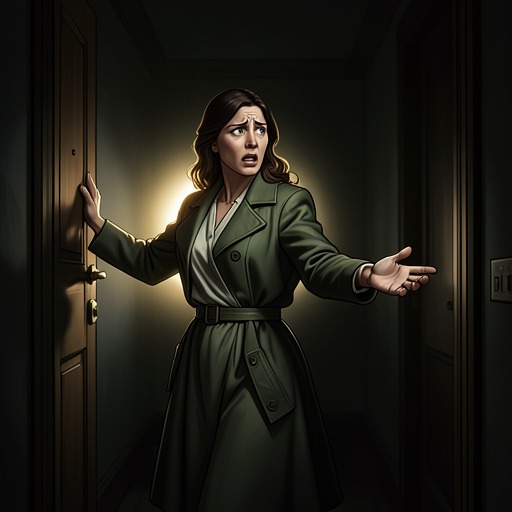
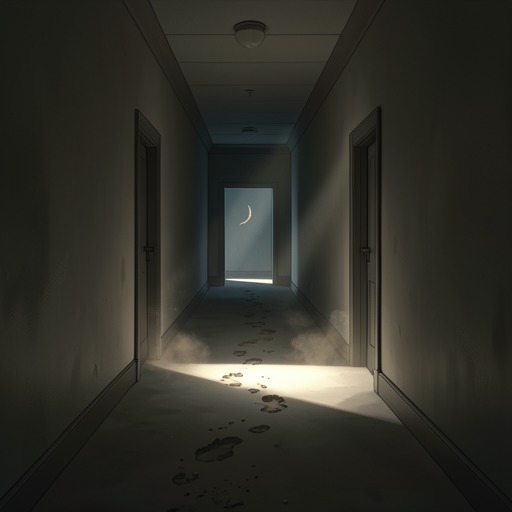
In the living room, Will finds a dark, doorless hallway that has appeared in the west wall. The corridor is associated with faint light and with the children’s voices, but the household’s Hi 8 camera cannot follow Will into it, and Karen freezes at the threshold, unable to enter the darkness. Will soon returns carrying Chad and Daisy, each child still clutching a homemade candle. The scene establishes the house as a space in which rescue requires crossing a boundary that recording technology and ordinary courage cannot automatically cross.
The labyrinth cannot be viewed from a position of total external mastery. No one ever sees it in its entirety, so knowledge of its intricacies must be derived from within. The distinction between participant and outside observer consequently breaks down: those who enter are also the only possible witnesses, while those who remain outside lack the spatial overview needed to understand what has happened. The same structure governs The Navidson Record itself. Its edits and sequences lead viewers from one apparent solution toward another ambiguity, promising a center or complete explanation while continually dissolving the possibility of a stable whole.
The house is therefore both a labyrinth and a machine for producing labyrinthine narration. It captures and restricts those who move through it, while the film permits wandering only through fragmented access, uncertain cuts, and partial viewpoints. Space and discourse mirror each other: neither offers a secure outside from which the entire structure can be possessed as knowledge.
Direction, Layout, and Material Rules
The house defeats not only distance but direction. Karen consults a Feng Shui master in Manhattan after the explorers’ presence begins to invade her home. She is told that the placement of ceramic animals, crystals, and plants has been incorrect and is advised to use the Pau Kua table, the I Ching, and the Lo Shu magic square with a compass. Such guidance depends on reliable distinctions among north, south, east, and west, but the house refuses to supply them.
Karen buys a compass while the men are conducting Exploration #2. Inside the house, the instrument will not settle on any direction. She assumes it is defective, returns to town, exchanges it for a new one, and tests the replacement in the store before bringing it home. The second compass fails in exactly the same way. The object that should provide transparent orientation becomes conspicuously useless, exposing the house’s refusal to participate in ordinary systems of reference.
Some spaces retain recognizable identities even as their dimensions and arrangements change. The Infinite Corridor, the Anteroom, the Great Hall, and the Spiral Staircase exist for everyone who encounters them, but their size and layout are not constant. Other regions never appear to repeat the same pattern twice. The house thus combines recurring architectural landmarks with continually altered connections, producing a spatial order that is neither random absence nor stable design.
The building retains certain constants even amid this variation. Its temperature is recorded as 32 degrees Fahrenheit plus or minus eight, and its interior is without light. These limited regularities do not make it habitable; instead, they suggest that the house obeys rules, though not rules available to conventional architectural grammar. Its persistent absence of light and its unstable circulation routes make every act of navigation costly, uncertain, and dependent on experience acquired inside the maze.
Effects on Bodies, Relationships, and Story
The house’s transformations produce consequences beyond architectural confusion. The Navidson Record has focused on how it affects particular people: Holloway Roberts becomes murderous and suicidal; Tom Navidson drinks himself into oblivion; Billy Reston loses his mobility; Sheriff Axnard enters denial; Karen flees with the children; and Will becomes increasingly isolated and obsessed. These outcomes show the house operating not as passive scenery but as a pressure that enters bodies, decisions, and relationships.
The spatial disorder has physiological force. Reston’s nausea reflects the disorientation produced by a place whose shifting dimensions may act upon the inner ear or upon the psychological sense of an inner labyrinth. The distinction between mental and physical disturbance becomes difficult to sustain because the house makes a failure of orientation materially felt. Its impossible architecture is experienced through sickness, fear, immobility, withdrawal, and compulsive investigation.
The house also destabilizes family space. The children’s voices travel through impossible distances; Karen cannot cross the threshold of the newly appeared hallway; Will enters it to retrieve them; and the adults’ reactions alter the children’s behavior before the children can understand the cause. A supposedly protective home becomes a site where parental authority, shared knowledge, and physical proximity fail together.
Later, Karen returns to the house in search of Will. The bookshelves upstairs are flush with the walls, and the closet space has vanished. The door on the north wall opens effortlessly, but the infernal corridor is gone. In its place is a closet barely a foot and a half deep, with white walls, a strip of molding, and daylight entering from the windows behind her. Karen laughs, but the laughter stops short: the horror she had prepared herself to confront has disappeared, leaving her without the danger that had also given her a reason to hope for finding Will.
This reversal makes the house’s instability more devastating than a fixed threat. When the corridor exists, fear blocks entry; when it vanishes, the absence of fear removes the route to rescue. The building offers no dependable object of confrontation, only changes in availability that repeatedly convert protection into exposure, knowledge into doubt, and hope into emptiness. The house on Ash Tree Lane remains a house in name and outline, but its decisive function is to make home itself impossible to inhabit securely.